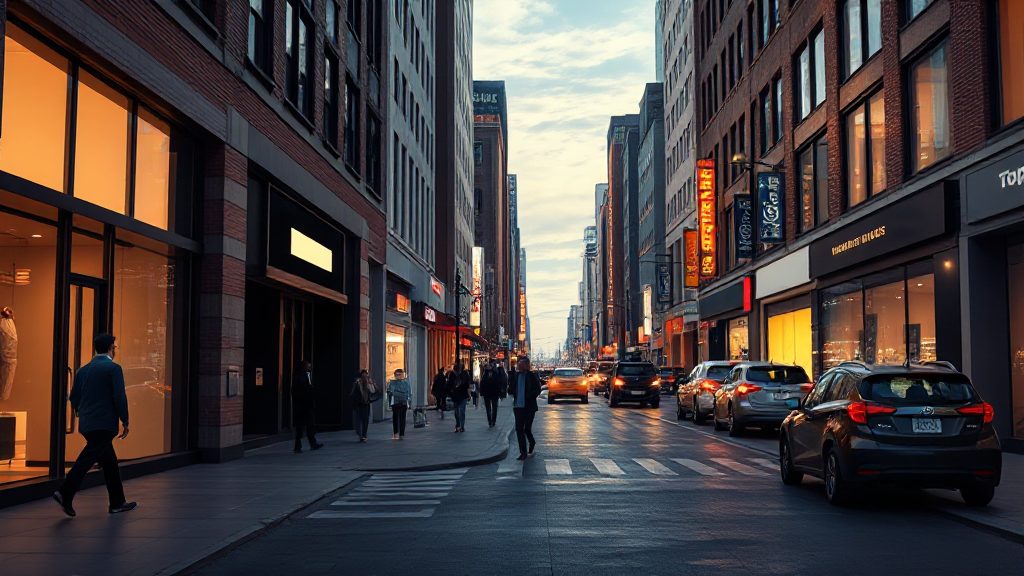
The Unlit Storefront on a Busy Street: Reading 03q
Walk down any busy commercial street and you will notice the rhythm of signage: awnings, menus, opening hours, a hand-lettered board. Then one unit breaks the pattern. No sign, no window display, no light behind the glass. Passersby draw a conclusion almost instantly: nobody is home, or somebody is hiding something. That is the most useful way to think about 03q, an unverified web address that behaves like an unlit storefront on an otherwise well-kept block. The short answer to what it is: a domain with no confirmed public identity, so the honest reading is caution rather than assumption.
This is not a review of a product or a service, because there is nothing verifiable to review. It is an exercise in street reading — the urbanist habit of judging a place by its frontage, its neighbors, and the small signals it leaves out. A shop with no sign is not automatically a bad shop. But on a street where every other door tells you what it sells, the blank one asks you to do more work before you step inside.
First Block: The Corner Where Every Sign Is Lit
Start at the corner. On a healthy block, the signage does the introductions. A bakery names itself, a tailor lists his hours, a dentist posts a license number. The conventions are boring and that is the point: they let a stranger decide in three seconds whether to cross the threshold. A domain that publishes a title, a description, a visible heading and a clear purpose is doing the same civic work online.
When those signals are missing, the street does not become dangerous — it becomes ambiguous. The passerby fills the gap with imagination, and imagination is usually darker than reality. That is why absence of signage is itself a message, even when the owner never intended to send one.
Here is what a careful walker looks for before forming an opinion:
- A name that matches the address, not a generic placeholder.
- Visible text on the front page, not just an image or a login box.
- Contact details, ownership clues, or a stated purpose.
- Neighbors: links, references, or mentions elsewhere on the street.
- Consistency between what the sign promises and what the window shows.
On the current evidence, the storefront at 03q fails most of these checks. That is not a verdict. It is a description of the frontage.
Second Block: Reading an Empty Window Without Inventing a Tenant
Stand across the street and resist the urge to guess. The most common mistake in urban reading is projecting a familiar business onto a blank facade. A numeric name and a .cash ending tempt the imagination toward money, betting, or finance, but that is pattern-matching, not evidence. The name is a label, not a business plan. Treating a domain suffix as a description of the tenant is like assuming every shop on a street called Market sells vegetables.
What we can say is narrower and more useful. There is no supplied title, no meta description, no visible heading, and no page text to interpret. In street terms, the unit is papered over. It may be under renovation, between tenants, or simply never fitted out. Each of those is a normal stage in the life of a building, and each looks identical from the pavement.
The practical consequence for a visitor is simple: you cannot verify what you cannot see. If a link, message, or recommendation sends you toward 03q, the burden of proof sits with the sender, not with you. Ask what the site is for, who runs it, and what happens after you arrive. A legitimate operator can answer those questions in plain language. A blank window cannot.
This is also where the street metaphor earns its keep. Cities tolerate empty units because the block as a whole still functions. Online, the block is the web, and a single unlit doorway does not ruin the neighborhood — but it does change how you walk past it.
Third Block: The Signals That Separate a Renovation from an Abandonment
Walk the same block a week later and look for change. Real streets leave traces: scaffolding, a permit notice, a delivery, a light on after hours. A site that is genuinely being built usually shows some of that motion over time — a title appears, a paragraph gets added, a contact page fills in. A site that is simply parked shows nothing, month after month.
So the right method is observation over time rather than a single glance. Keep a short mental checklist and revisit it:
- Note what the front page shows today, including whether any text is visible at all.
- Check whether the domain name appears in independent references, not just in messages pushing you toward it.
- Look for a stated purpose before you enter any details or follow any instructions.
- Compare the site’s claims with what you can confirm elsewhere.
- Decide based on evidence, and be willing to walk on.
Caution is not suspicion. You can treat an unlit storefront politely — no accusations, no rumors — while still declining to step inside until the sign goes up. That posture protects you without requiring you to make claims you cannot support.
The same discipline applies to how you talk about it afterward. Saying “I could not verify this address” is accurate. Saying “this address is a scam” is a conclusion the evidence does not license. Urbanists learn to describe the streetscape before they editorialize about it.
Fourth Block: How to Walk Past — and What Would Change the Reading
End the walk at the far corner and look back. The unlit unit is still there, and the block still works. The lesson of 03q is not that blank storefronts are sinister; it is that a storefront earns trust by publishing itself. Names, purposes, contacts, and visible text are the awnings and hours boards of the web. When they appear, the passerby can make a decision in seconds, the way she does at the bakery.
For now, the sensible route is to treat the address as unconfirmed. Do not enter personal details, do not act on instructions from an unidentified page, and do not repeat claims about the operator that no one can verify. If you need to reference it, describe it plainly as an address without a public identity.
What would change the reading is specific and unglamorous: a clear title, a stated purpose, a named owner, a way to make contact, and independent mentions elsewhere on the street. Any one of those would be a light in the window. Until then, the honest verdict from the pavement is the one a good urbanist always gives an empty unit — noted, unverified, and worth watching rather than entering.
About the Author